

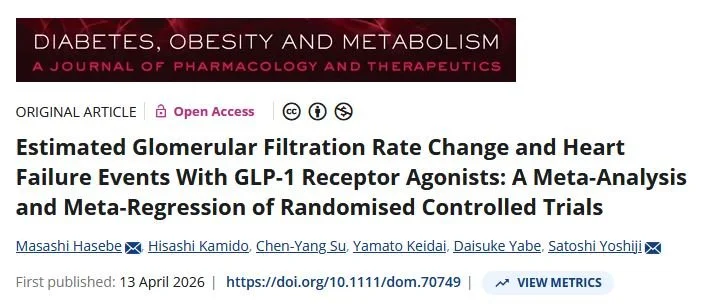
We are pleased to highlight a new publication in Diabetes, Obesity and Metabolism showcasing important contributions from members of our CERC community. This study, co‑authored by Masashi Hasebe, Chen‑Yang Su, and Satoshi Yoshiji, provides novel insights into the mechanisms underlying cardiovascular protection in people treated with glucagon‑like peptide‑1 receptor agonists (GLP‑1RAs).
The article, titled “Estimated Glomerular Filtration Rate Change and Heart Failure Events With GLP‑1 Receptor Agonists: A Meta‑Analysis and Meta‑Regression of Randomised Controlled Trials,” advances our understanding of how kidney function may influence heart failure outcomes in cardiometabolic disease.
About the Study
GLP‑1 receptor agonists are now widely used in the management of type 2 diabetes and obesity, with growing evidence supporting their cardiovascular benefits. However, the biological pathways linking these therapies to improved clinical outcomes remain incompletely understood.
In this study, the authors conducted a large‑scale meta‑analysis and meta‑regression of 11 randomized, placebo‑controlled trials, including 90,867 participants and 2,863 heart failure events, to examine how treatment‑related changes in clinical markers relate to heart failure risk reduction.
The analysis specifically evaluated whether improvements in:
Kidney function (measured by estimated glomerular filtration rate, eGFR)
Body weight
Systolic blood pressure
Heart rate
were associated with differences in heart failure outcomes across trials.
Key Findings
GLP‑1RAs significantly reduced the risk of heart failure events, with a pooled hazard ratio of 0.86, confirming their cardioprotective effect.
Improvement in kidney function emerged as a key driver of benefit: each incremental increase in annualized eGFR was associated with a 21% lower risk of heart failure events at the trial level.
In contrast, changes in body weight, systolic blood pressure, and heart rate were not significantly associated with heart failure risk reduction, suggesting that kidney function plays a more central mechanistic role in this context.
Why This Matters
These findings help refine our understanding of how GLP‑1RAs confer cardiovascular protection. While these therapies are often recognized for their effects on glycemic control and weight reduction, this study highlights the importance of renal function as a mediator of heart failure risk.
By identifying kidney function as a key contributor, this research:
Provides mechanistic insight into cardiometabolic therapies
Suggests new pathways for risk stratification and treatment optimization
Reinforces the importance of integrated cardio‑renal approaches in precision medicine
Access the Article
Read the full publication via Wiley Online Library here.